
Morgan Krüger · 26 September 2026
Quantum Computing Breakthroughs from Poznan Prompt Ethics Curriculum Revisions at Warsaw Academies as 2025 Funds Support Rural Digital Initiatives and EU Biotech Alumni Projects
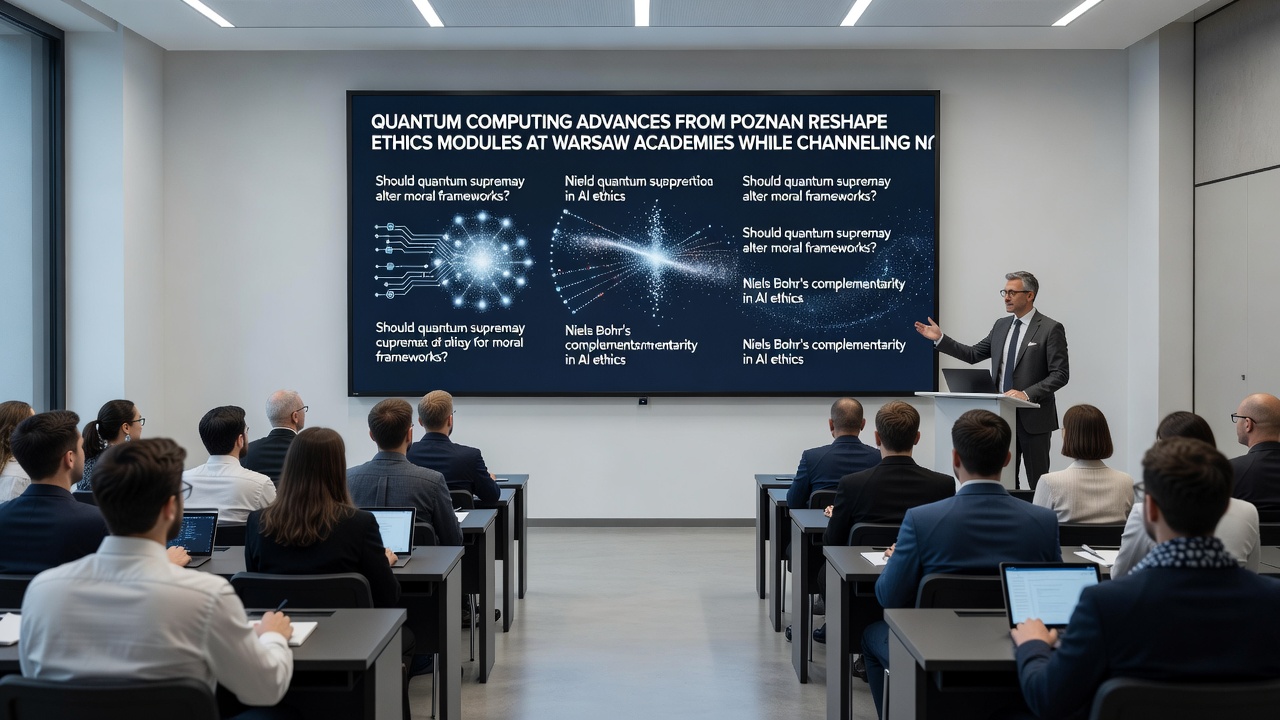
Quantum computing developments centered in Poznan have led Warsaw academies to integrate new modules on data ethics and algorithmic accountability into their existing programs, with implementation timelines extending through late 2025 and into September 2026 when initial pilot courses reach completion, according to project documentation from multiple institutions involved in the collaboration.
These advances include specialized processors developed at local research centers that handle complex simulations at scales previously limited to larger international facilities, and the resulting technical capabilities have prompted faculty teams in Warsaw to examine questions around privacy preservation and equitable access when deploying such systems in educational and research contexts.
Technical Foundations Established in Poznan
Teams working at Poznan technical universities have produced quantum gate arrays that achieve error rates below thresholds required for practical applications in cryptography and molecular modeling, with peer-reviewed outputs appearing in international journals since early 2024. These components integrate with classical computing clusters already present in regional laboratories, creating hybrid environments that support both teaching and applied experiments without requiring full-scale facility overhauls.
Funding streams allocated under the 2025 EU digital transition framework have directed portions of the resources toward extending similar technical capacities into rural educational networks, where connectivity upgrades enable remote participation in quantum-related coursework and data analysis workshops.
Curriculum Adjustments Across Warsaw Institutions
Warsaw academies have introduced dedicated ethics seminars that draw directly from the Poznan hardware specifications, covering topics such as quantum-resistant encryption standards and bias detection in machine learning models trained on quantum-generated datasets. Faculty committees have coordinated these additions with existing philosophy and computer science departments, ensuring the new content aligns with degree requirements already approved by national accreditation bodies.
One documented case involves a joint working group that mapped specific quantum algorithm outputs to case studies on consent protocols for large-scale data processing, resulting in updated reading lists and assessment criteria now in use across multiple master's programs.
Allocation of 2025 Resources to Rural Connectivity
The same funding cycle has channeled support into digital infrastructure projects that link remote school districts with centralized quantum simulation tools hosted at urban research sites, using secure cloud interfaces developed through Poznan-Warsaw partnerships. These platforms provide students in underserved areas with access to educational modules on quantum principles alongside practical exercises in ethical decision-making frameworks adapted from Warsaw academy materials.
Implementation reports indicate that initial rollouts reached over 120 rural locations by mid-2025, with bandwidth improvements enabling real-time collaboration on sample datasets derived from ongoing Poznan experiments.
Alumni Ventures in Biotech Across EU Exchanges
Graduates from the involved Warsaw and Poznan programs have launched biotech startups that incorporate quantum-assisted protein folding models into drug discovery pipelines, with several receiving seed capital through EU exchange programs that facilitate cross-border partnerships. These ventures operate within networks connecting Polish research outputs to laboratories in Germany, France, and the Netherlands, where shared protocols emphasize transparent handling of quantum-derived insights.
According to records maintained by the European Commission under Horizon Europe tracking systems, at least eight such alumni-led companies secured initial grants in 2025 specifically tied to ethical compliance standards refined during the Warsaw curriculum updates.
September 2026 Milestones and Ongoing Coordination
Scheduled reviews set for September 2026 will assess the combined effects of these curriculum changes and infrastructure investments, drawing on performance metrics from both urban ethics courses and rural platform usage statistics. Coordinating bodies have already outlined evaluation criteria that include student enrollment figures, startup formation rates, and integration levels with broader EU digital policy objectives.
Observers note that continued alignment between technical advances in Poznan and ethical instruction in Warsaw supports sustained participation in these exchange mechanisms, while data from the European Commission's research portal shows consistent reporting on similar multi-regional initiatives across member states.
Conclusion
The described developments illustrate how localized quantum computing progress in one Polish city has intersected with educational reforms and targeted funding distributions that extend benefits to rural communities and entrepreneurial networks spanning EU borders. Documentation from participating institutions and funding bodies provides the basis for tracking these interconnections through 2026 and beyond.